At a Glance
- What: A redesigned neck for the Hybrid III 6-year-old crash-test dummy, developed as a finite element model in LS-DYNA and scored against pediatric biomechanics targets across six crash and loading simulations.
- Why: The existing 6-year-old dummy neck is largely scaled from adult geometry and tissue properties, but children's necks behave differently. A more child-like neck would make injury predictions for car seats and restraints more trustworthy.
- My role: On a team of five, I did all of the CAD and led the neck's mechanical design, built our team's bending response corridor, and ran the mesh-size study that cut simulation runtime from hours to minutes. I also recreated the existing Hybrid III 6-year-old neck in CAD to understand the baseline design.
Starting Point: Recreating the Hybrid III Neck
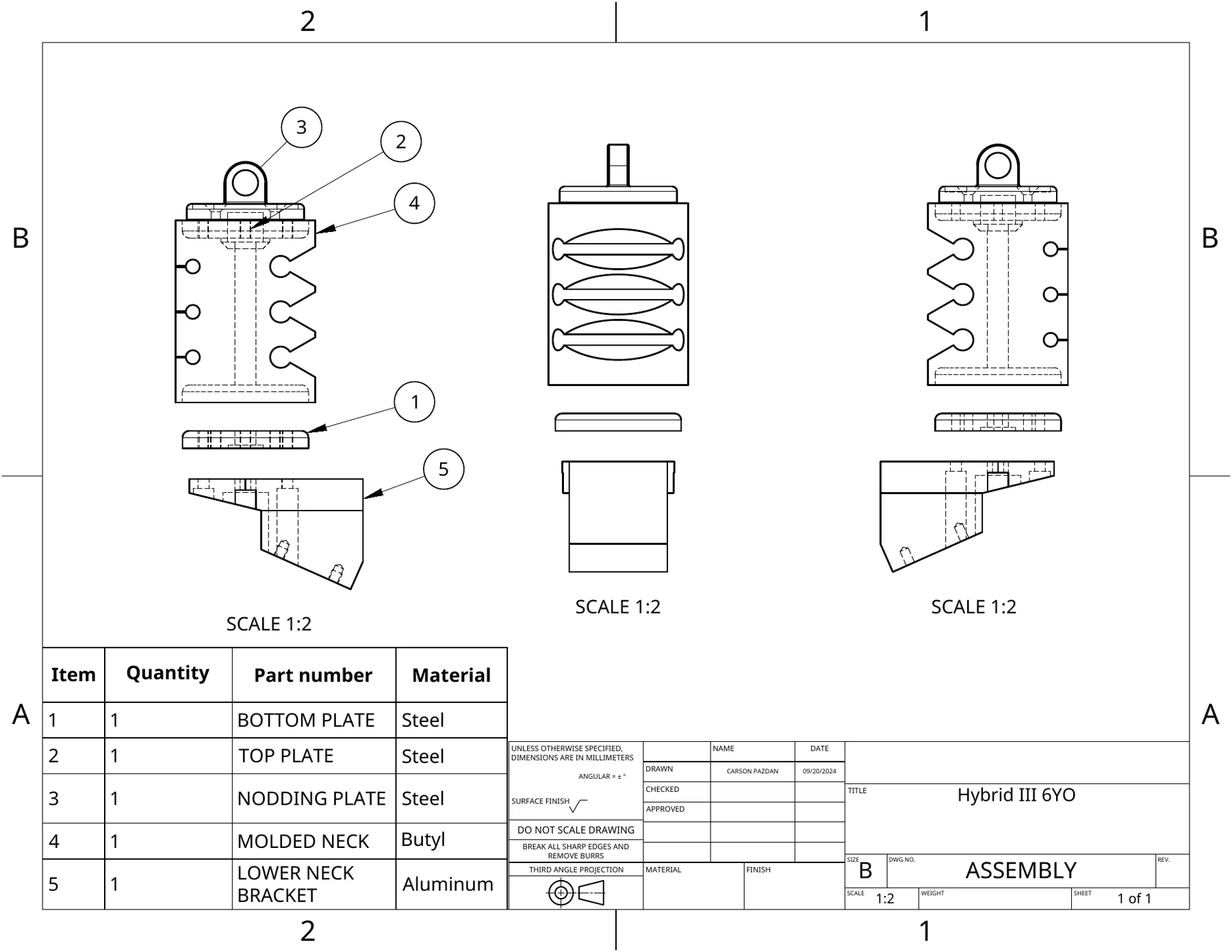
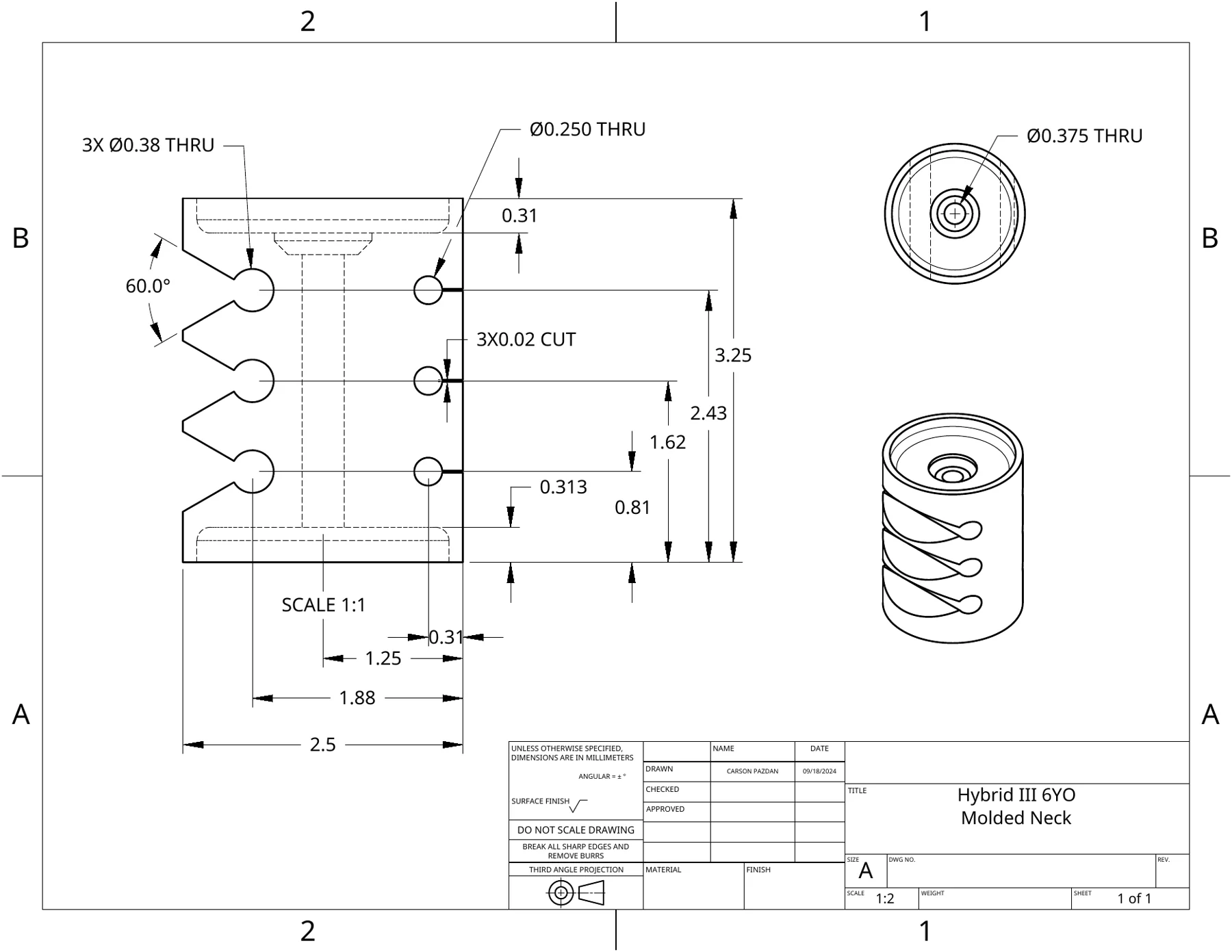
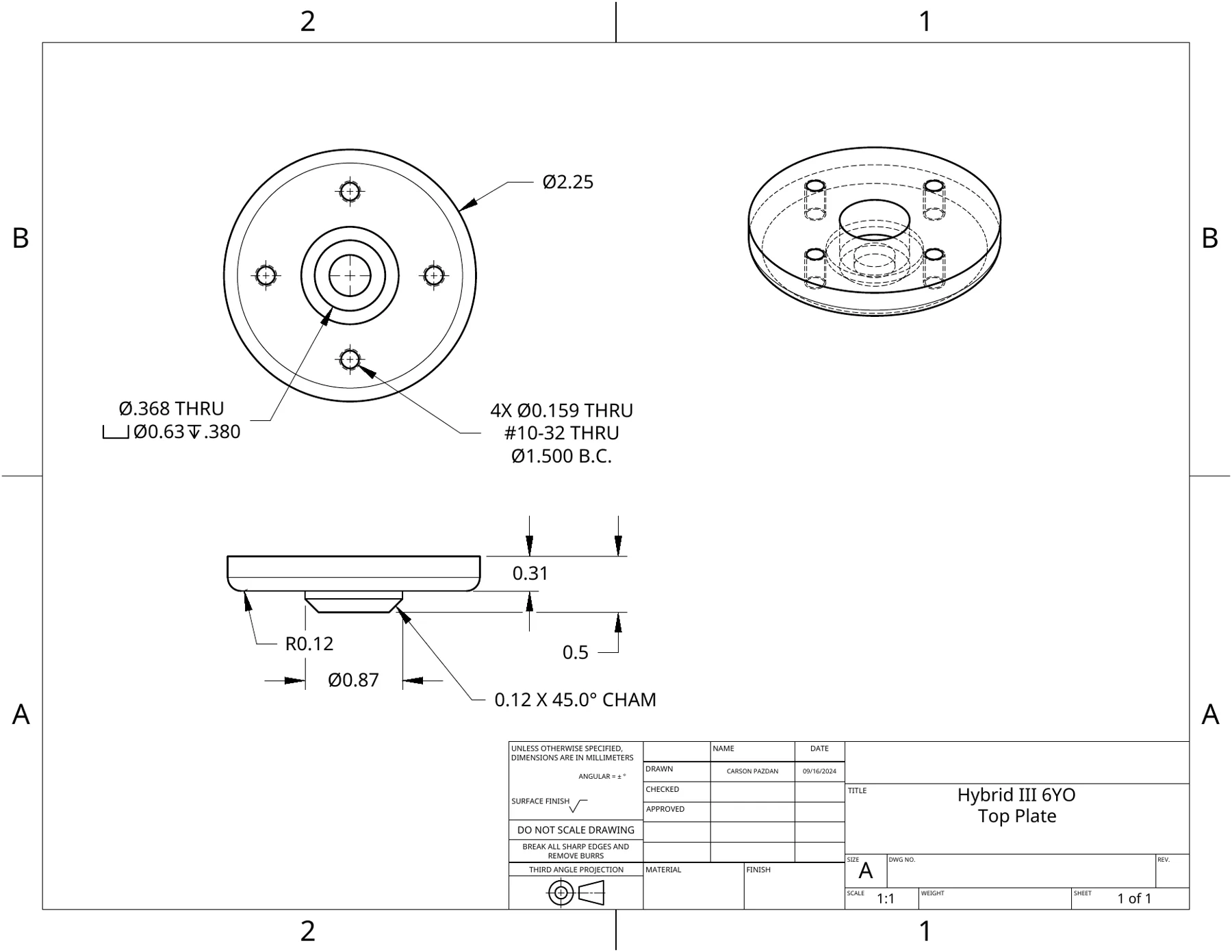
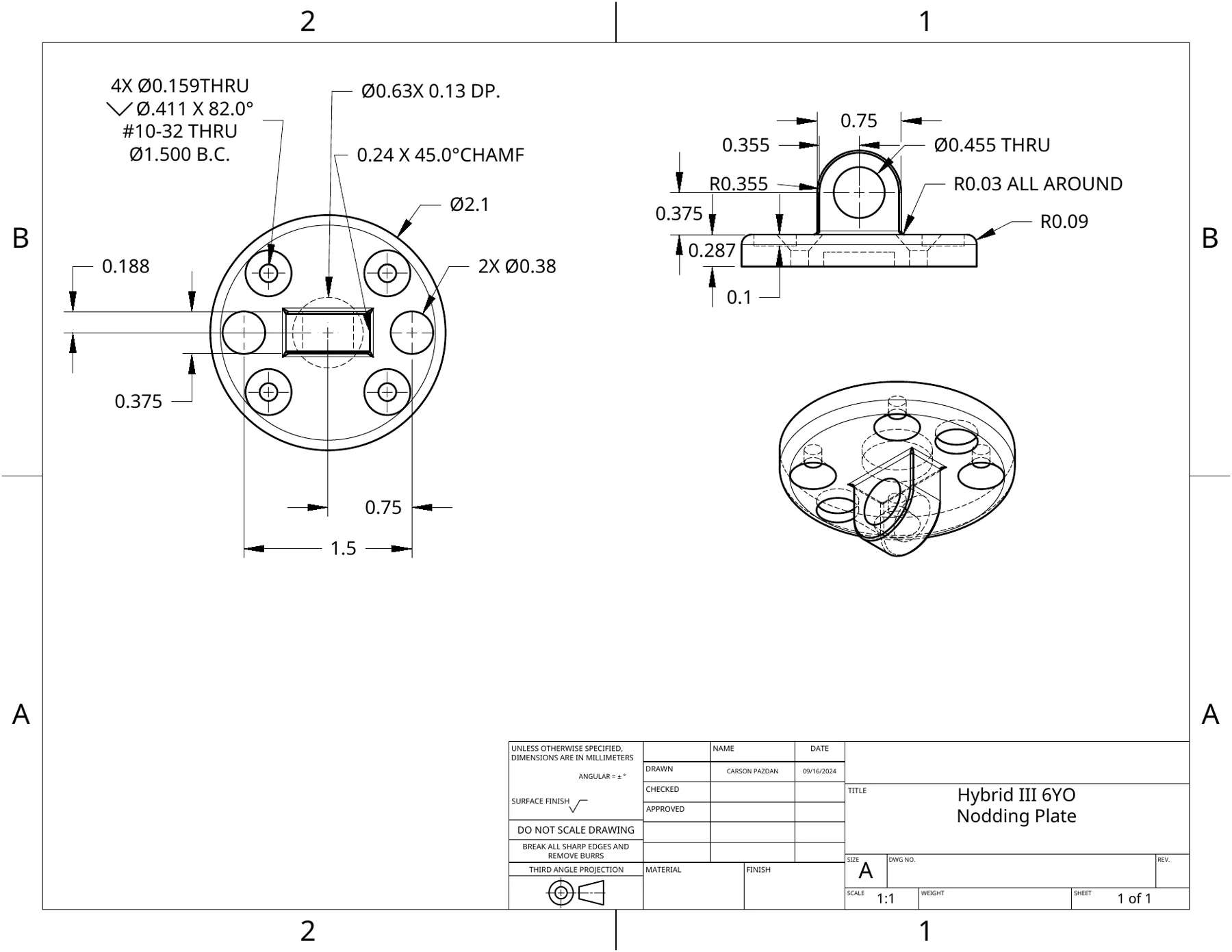
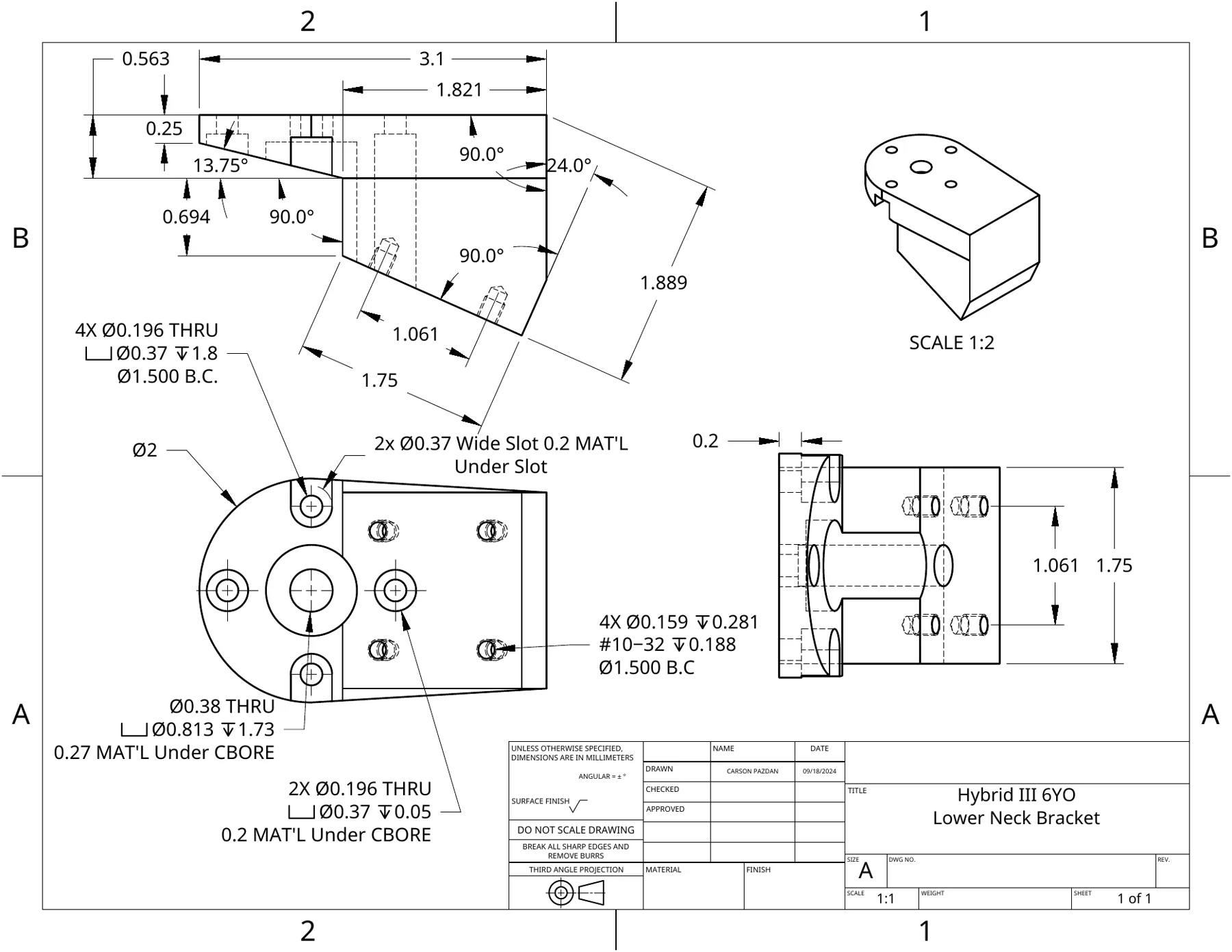
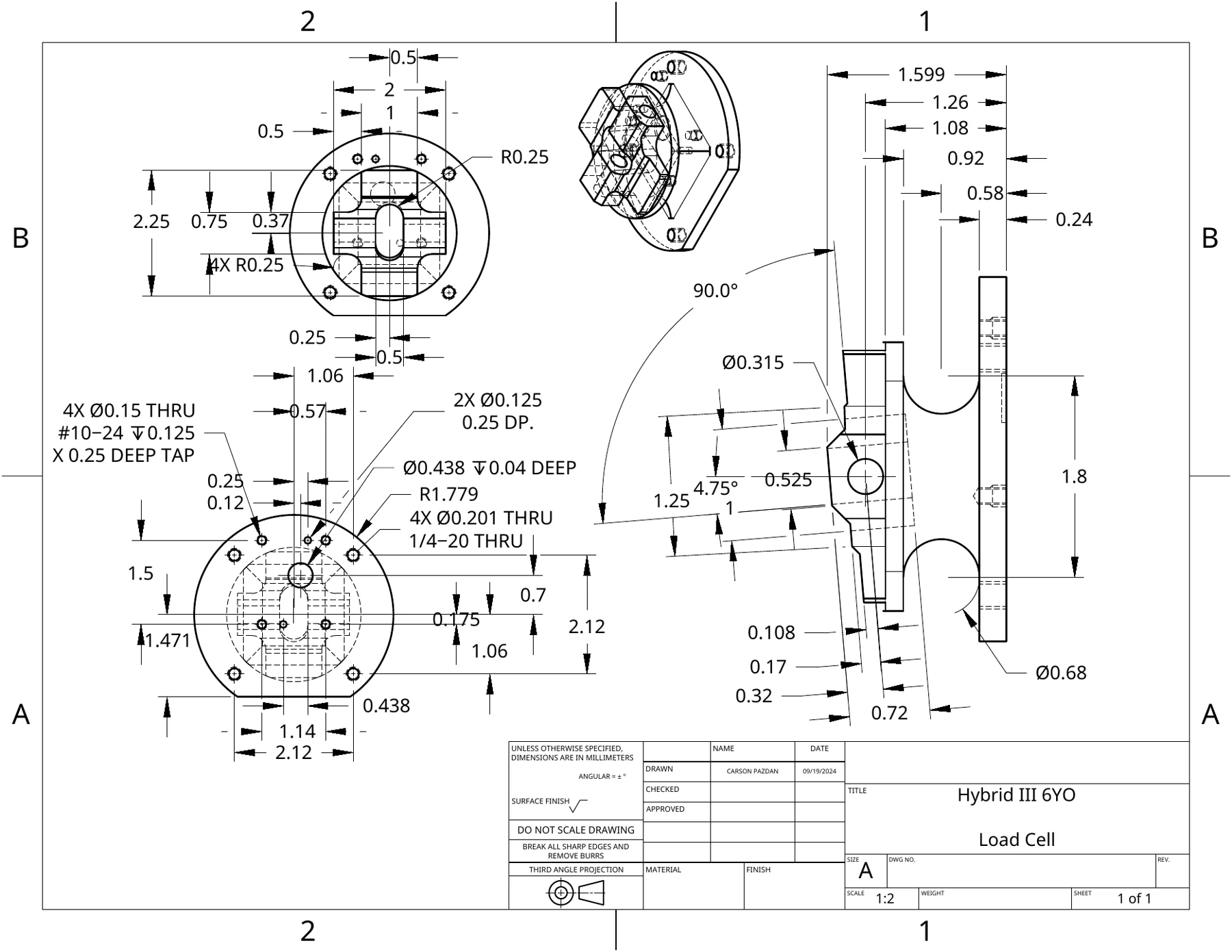
Before redesigning anything, I modeled the existing Hybrid III 6-year-old neck and drew each part: the molded butyl neck, top and nodding plates, lower neck bracket, and load cell. Working through how its slotted rubber column and rigid plates produce its response gave us the design vocabulary for the redesign.
Building the Bending Target
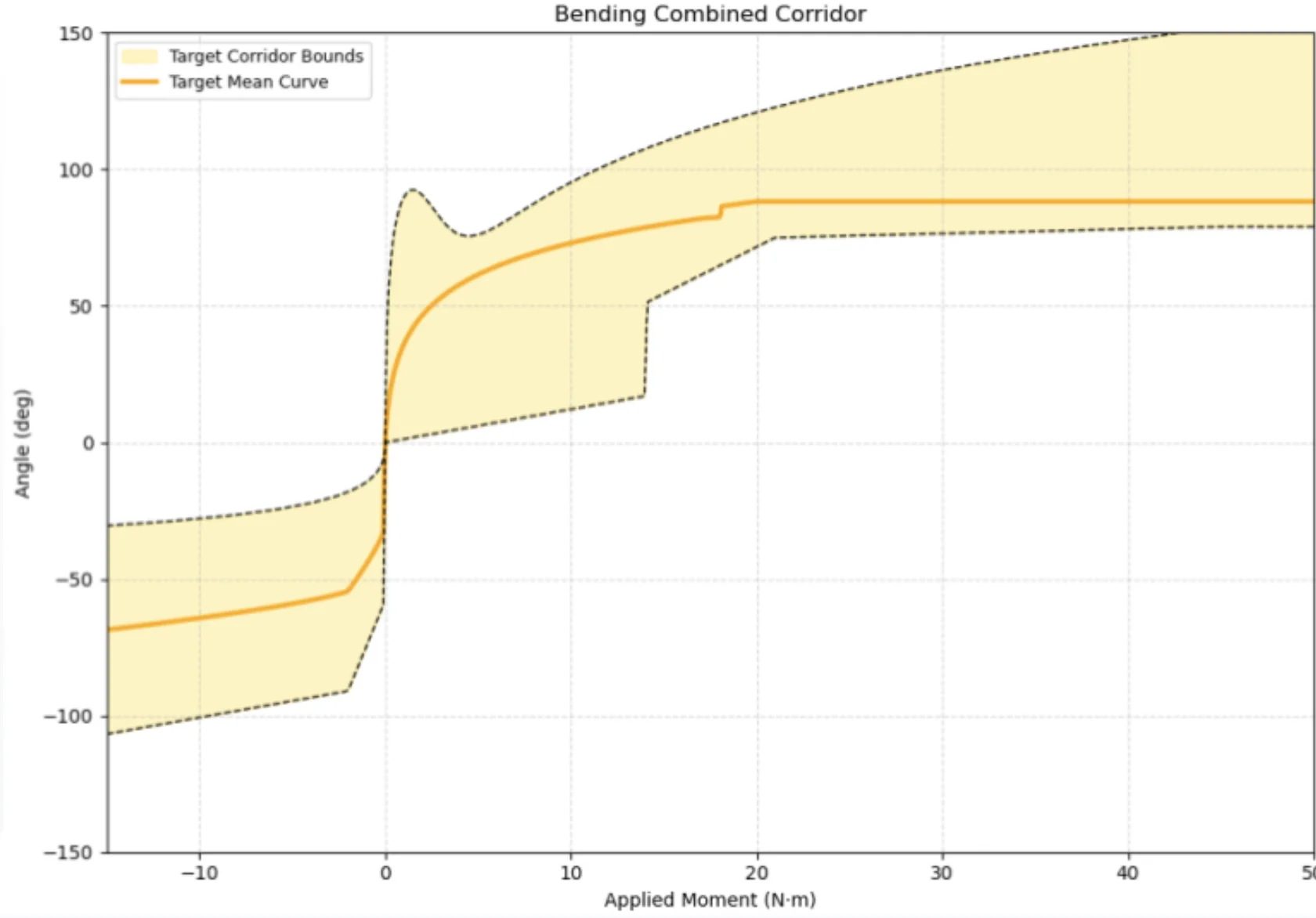
A neck is only "right" if it bends like a child's, so each team defined response corridors: acceptable ranges of force or moment versus displacement or angle. I built our team's bending corridor in two parts:
- Passive response (low loads): segment-by-segment moment–angle curves from 6-year-old cadaver data (Luck, 2019), combined into a full cervical spine curve.
- Active response (higher loads): muscle-driven behavior fit through maximum range-of-motion data from children (Arbogast et al., 2007) and maximum voluntary neck moments (Vincent et al., 2006).
- Blending the two: a sigmoid activation function (after Vasavada et al., 1998) shifts weight from the passive curve to the active curve as moment increases, mimicking how muscles are recruited under load.
The approach held up at low loads but over-extrapolated to non-physical angles at high moments. For validation, the class combined every team's bounds with the published Hybrid III 6-year-old corridor (Irwin & Mertz, 1997) into the final corridor shown here, which drew most heavily on my team's corridor.
The Redesign
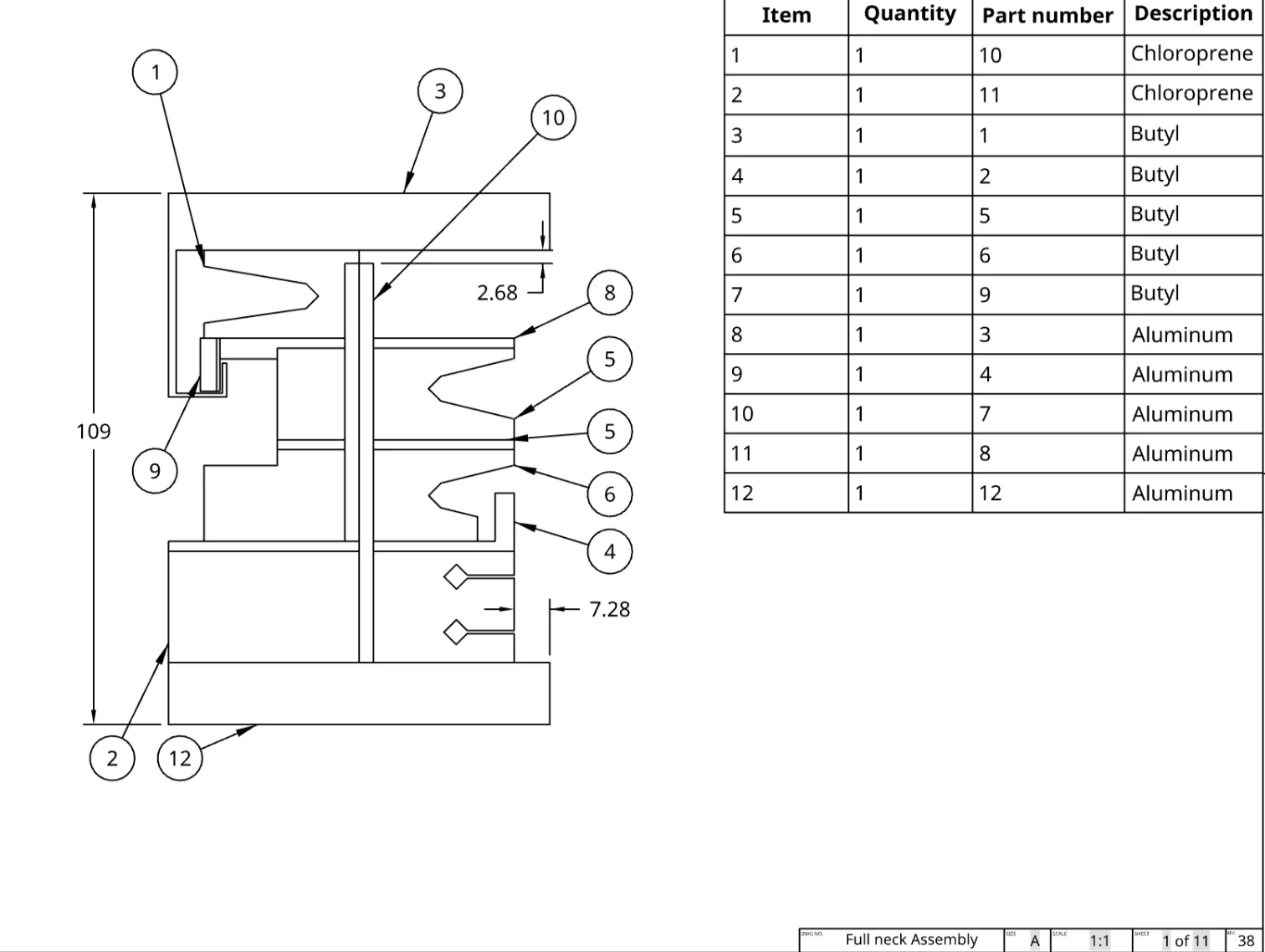
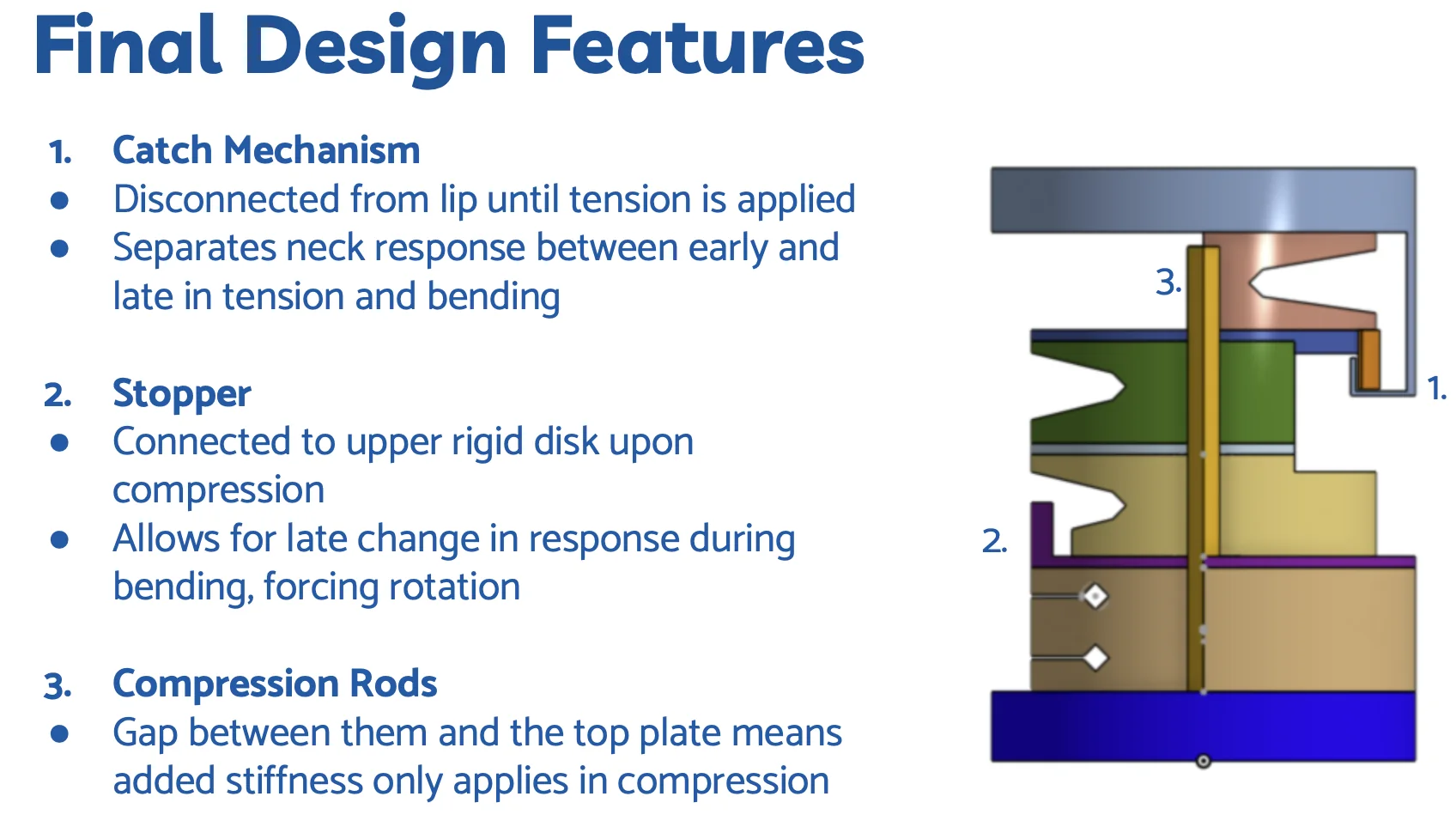
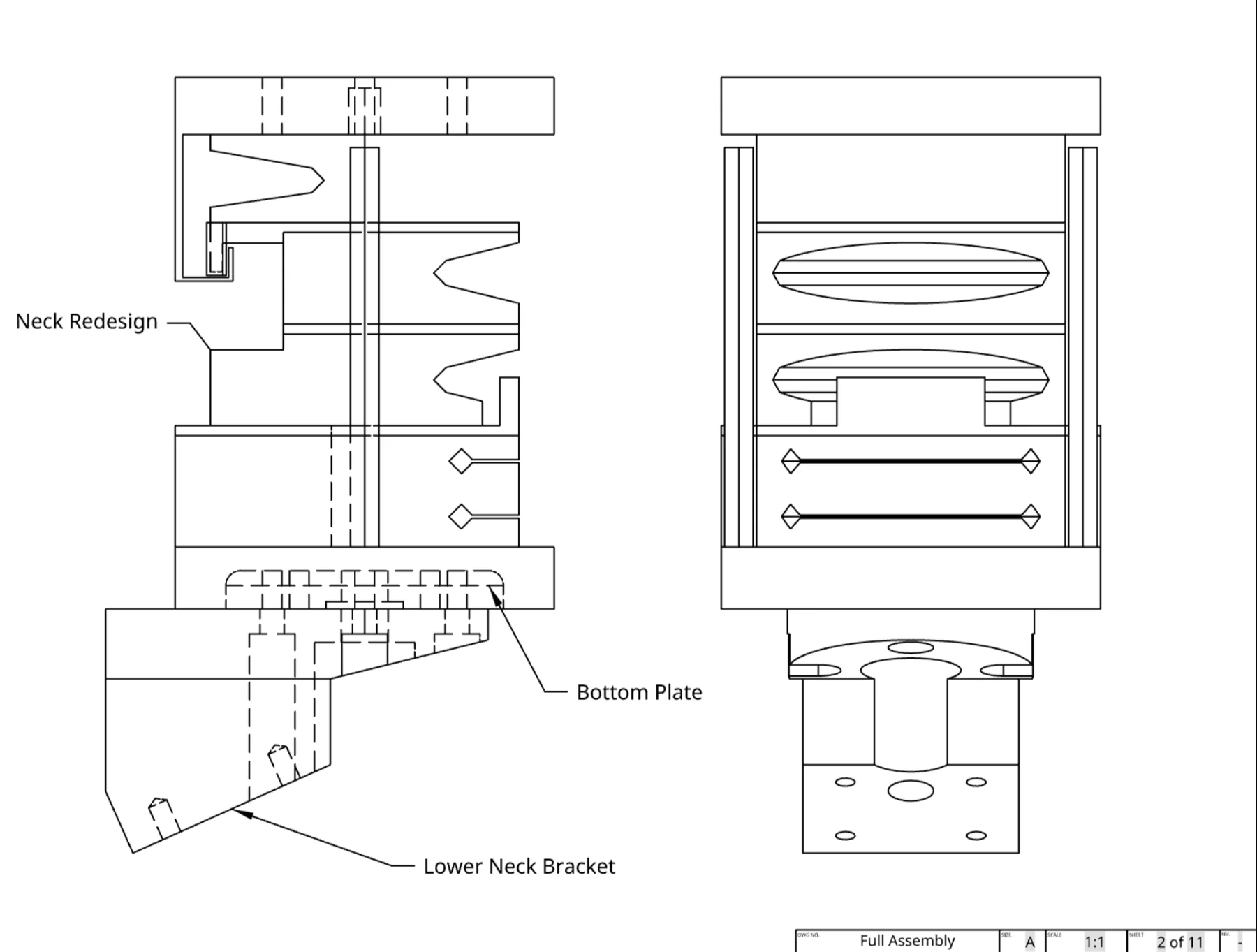
The final design keeps the Hybrid III's mounting interfaces and exact 109 mm length so it drops into the existing dummy, but rebuilds the column from 12 parts: butyl rubber segments with cut slits, chloroprene rods, and aluminum plates. The key idea was to make the response change over the course of a crash, the way a real neck does:
- Catch mechanism: the top plate hangs free of a lip until tension builds, so early bending lets the head lag naturally and the catch only engages later to stop the head from whipping forward.
- Stopper: a rigid lip contacts the upper disk only after enough rotation, adding a late moment that drives further rotation.
- Compression rods: stiffer chloroprene rods sit just short of the top plate, so they add stiffness only in compression and stay out of the way in bending and tension.
- Slit geometry: cutouts in the rubber segments set how easily each level bends. The lowest, most loaded segment has smaller cuts and a wider rear section so it doesn't overextend.
Simulation and Iteration
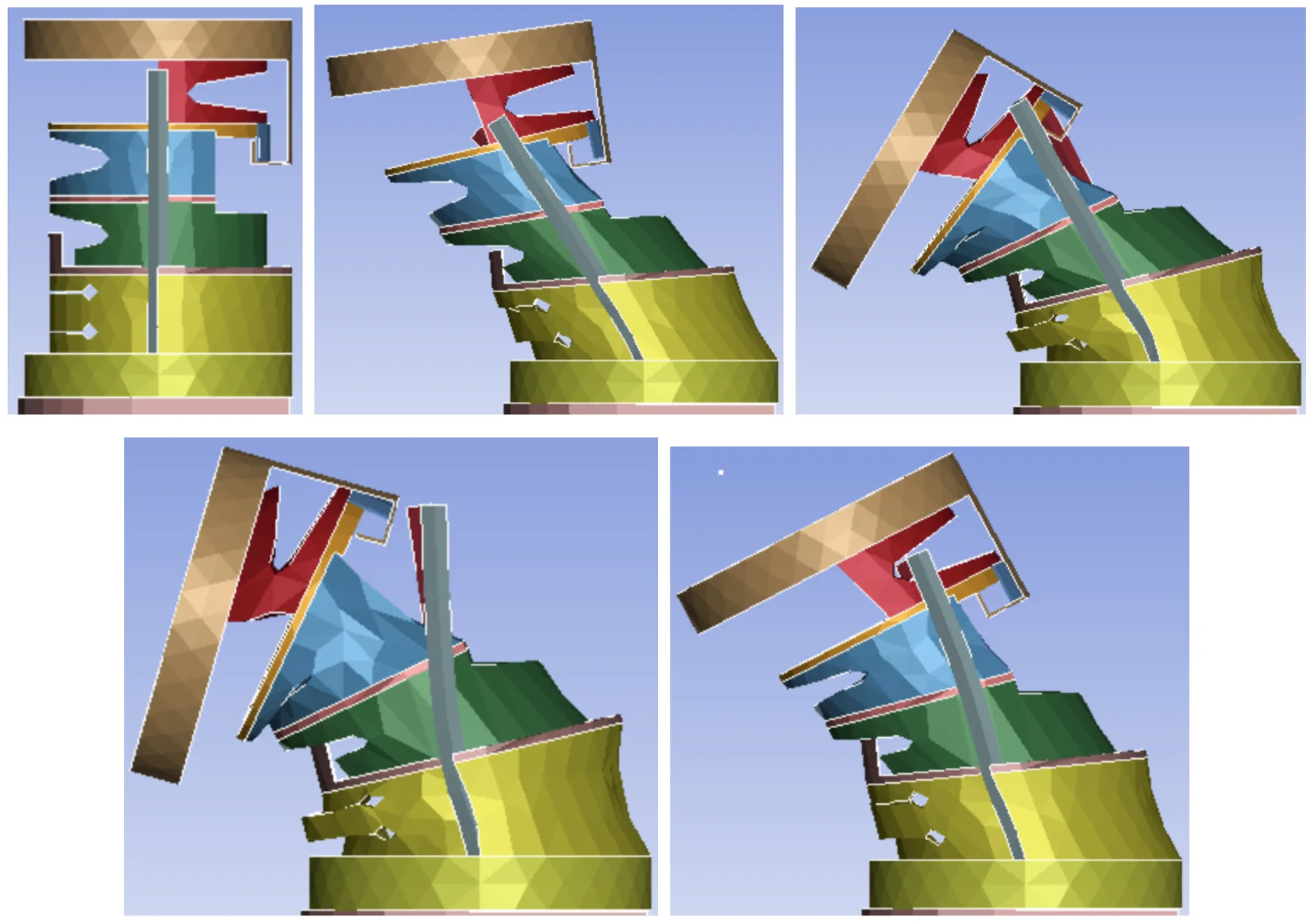
Every design was run through six standardized LS-DYNA simulations (tension, compression, flexion, extension, a frontal sled pulse (NBDL), and a CHOP sled test) using the class's automated MATLAB/LS-PrePost pipeline, then scored against the corridors with a weighted objective rating. We iterated through 38 designs.
Making iteration fast enough. Early models used 2 mm elements around the fine, curved slit geometry, and a single NBDL run took 14 hours. I redesigned the curved slit and rod features as rectangular geometry so the neck could mesh cleanly at larger element sizes, then ran a mesh-size study to find the limit: 8 mm elements preserved the expected response, while 10 mm was too coarse for the simulations to run. At 8 mm, the NBDL run dropped from 14 hours to about 20 minutes, which is what made 38 iterations practical.
Results
We weighted the scoring toward the tests most tied to neck injury in a frontal collision, especially the frontal sled test (NBDL), and designed for those first.
| Loading case | Score (0–1) | Highlights |
|---|---|---|
| Tension | 0.94 | 100% late-phase corridor fit; stiffness within 8% of target |
| NBDL (frontal sled) | 0.28 | Full credit on forward displacement; moderate head–neck lag fit |
| Extension | 0.24 | Good maximum-angle agreement |
| CHOP sled | 0.18 | Captured the shape of head rotation; conservative peak velocity |
| Flexion | 0.15 | Weak early-phase fit; stays below peak angle at high moments |
| Compression | 0.27 | Partial corridor fit; stiffness not yet tuned |
| Overall weighted score: 0.30. |
Tuning for NBDL came at a cost in flexion and compression, and the final neck wasn't our highest-scoring iteration overall. We chose it because its behavior comes from deliberate mechanisms (the catch, stopper, and rods) rather than luck, which makes it a better base for further tuning. The next step would be balancing stiffness across loading modes, starting with flexion and compression.
What I Took Away: Everything Is a Trade-off
The through line of this project, from the corridor to the mesh to the CAD, was deciding what to give up. Cadaver data, animal data, and scaled adult data each capture a child's neck well in some ways and poorly in others. A finer mesh is more faithful to the geometry but too slow to iterate on. A neck tuned for one crash test drifts in another. The goal is to maximize relevance to the problem you're actually solving, which here is predicting neck injury in a frontal crash, and to knowingly give up realism that matters less to that task.
Next project
Implantable Electrode Fabrication · Viventi Lab, Duke